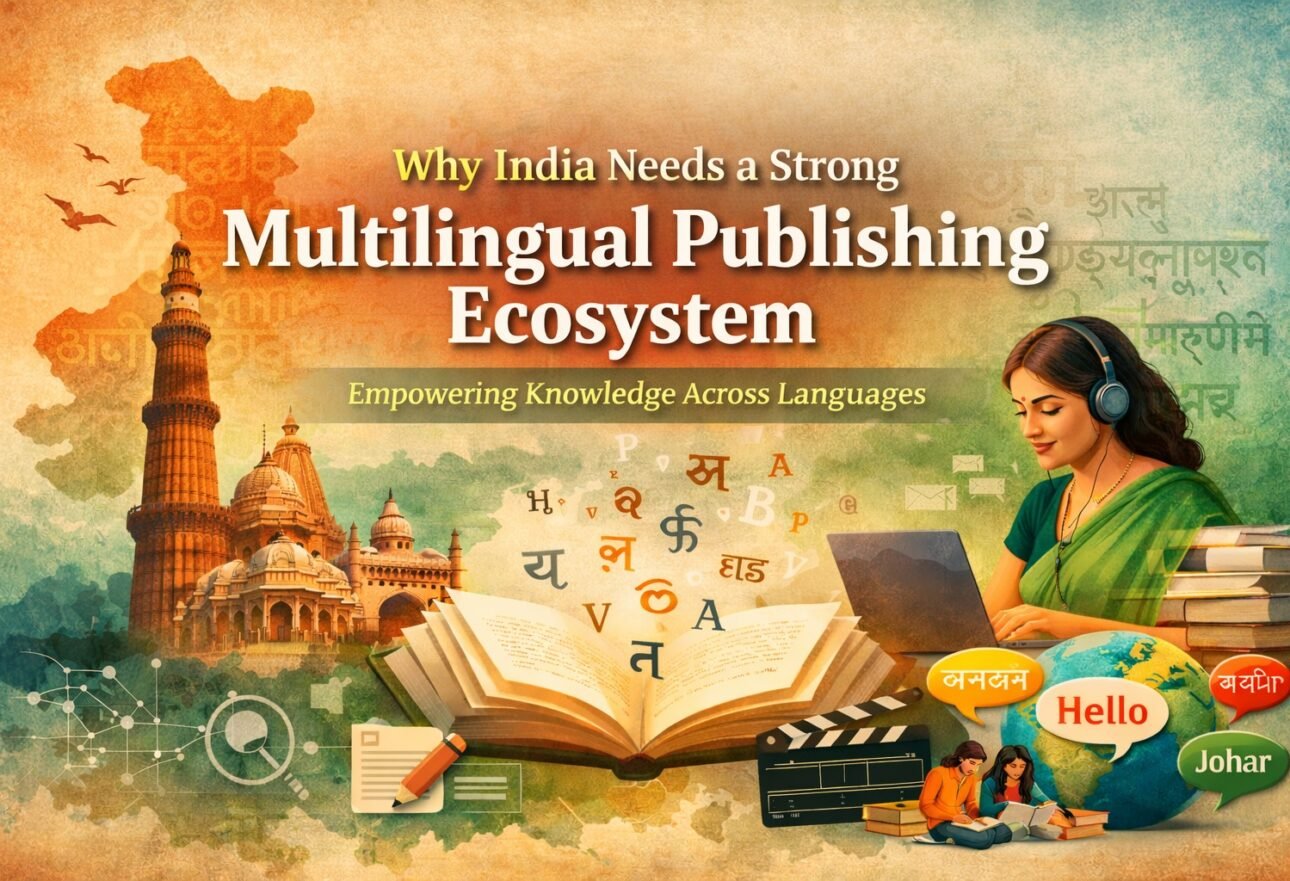
India is one of the most linguistically diverse nations in the world, home to hundreds of languages and thousands of dialects. From Hindi and Bhojpuri to Santhali, Tamil, Marathi, and beyond, every language carries centuries of history, culture, and collective memory. Yet, despite this richness, India still lacks a strong, organized, and inclusive multilingual publishing ecosystem.
This gap limits the reach of knowledge, restricts cultural exchange, and prevents millions of readers from accessing meaningful content in their own languages. Building a strong multilingual publishing system is no longer a choice—it is a necessity.
The Language Divide in Indian Publishing
Most high-quality academic, professional, and research content in India is produced in English. While English serves as a link language, it does not represent the daily reality of most Indians. A large section of the population feels more comfortable reading and learning in their regional languages.
At the same time, regional literature often remains confined within state boundaries. A powerful novel written in Bhojpuri may never reach a Malayalam reader. A research paper in Bengali may never be available in Hindi. As a result, knowledge remains fragmented and inaccessible.
This language divide creates inequality in education, awareness, and opportunities.
Why Translation Alone Is Not Enough
Many people assume that translation solves the problem. In reality, translation is only the first step.
Word-to-word translation often fails to capture:
-
Cultural references
-
Emotional depth
-
Regional expressions
-
Social context
Poor-quality translations can distort meaning and weaken the original message. This is why localization—adapting content to cultural and social realities—is equally important.
A strong publishing ecosystem ensures that translated content is accurate, meaningful, and relevant to its readers.
Challenges Faced by Publishers and Authors
Indian publishers and authors face several obstacles in building multilingual content:
1. Limited Resources
High-quality translation, editing, and design require skilled professionals and financial investment. Many publishers lack these resources.
2. Market Uncertainty
Regional translations often have uncertain sales potential, making publishers hesitant to take risks.
3. Lack of Skilled Networks
Finding reliable translators, editors, and proofreaders for multiple languages is difficult.
4. Fragmented Systems
There is no centralized platform connecting authors, translators, publishers, and institutions.
Because of these challenges, many valuable works never get translated or published widely.
The Impact on Education and Social Development
When quality content is unavailable in regional languages, it directly affects education and development.
Students struggle to understand complex subjects in unfamiliar languages. Community workers cannot access training material easily. Health and social awareness campaigns fail to reach grassroots levels.
A multilingual publishing ecosystem ensures that:
-
Education becomes more inclusive
-
Information reaches rural and marginalized communities
-
Public awareness improves
-
Skill development becomes accessible
Language should never be a barrier to progress.
Preserving India’s Cultural Heritage
India’s regional and indigenous languages are living repositories of folklore, philosophy, and social history. Many of these languages are under threat due to lack of documentation and publication.
Without publishing support:
-
Oral traditions disappear
-
Folk literature remains unpublished
-
Local knowledge is lost
Multilingual publishing plays a vital role in preserving these traditions for future generations.
The Role of Technology and Digital Platforms
Digital publishing, e-books, online journals, and learning platforms have created new opportunities. However, technology alone cannot solve linguistic problems.
Without strong language support systems, digital content remains limited to a few dominant languages. A robust ecosystem ensures that technology becomes a tool for inclusion rather than exclusion.
How Revival Bharat Contributes to This Vision
Revival Bharat works to strengthen India’s multilingual publishing ecosystem by providing:
-
Culturally accurate translation and localization
-
End-to-end publishing solutions
-
Professional editing and proofreading
-
Training module development
-
Subtitling and multimedia translation
-
Research and content enhancement
By connecting language professionals, authors, publishers, and institutions, Revival Bharat helps content travel across linguistic boundaries with quality and credibility.
Building a Knowledge-Driven Nation
A strong multilingual publishing ecosystem is essential for building a knowledge-driven and culturally confident India. It ensures that:
-
Ideas flow freely across regions
-
Writers gain wider recognition
-
Readers gain diverse perspectives
-
Institutions communicate effectively
-
Society becomes more informed and inclusive
When knowledge moves across languages, it strengthens national unity.
Conclusion
India’s diversity is its greatest strength. But this strength can only be fully realized when ideas, stories, and knowledge are accessible in every major language.
A strong multilingual publishing ecosystem bridges gaps between regions, cultures, and communities. It empowers readers, supports authors, and preserves heritage.
Initiatives like Revival Bharat are not just publishing ventures—they are part of a larger movement to make India’s intellectual and cultural wealth truly national and global.
By investing in multilingual publishing today, we invest in a more connected, informed, and inclusive tomorrow.